
Donor Spotlight: Andrea Morse Straus on Getting to Do What You Love as a Career and Supporting Others to Do the Same
Written by Fiona Dunlap
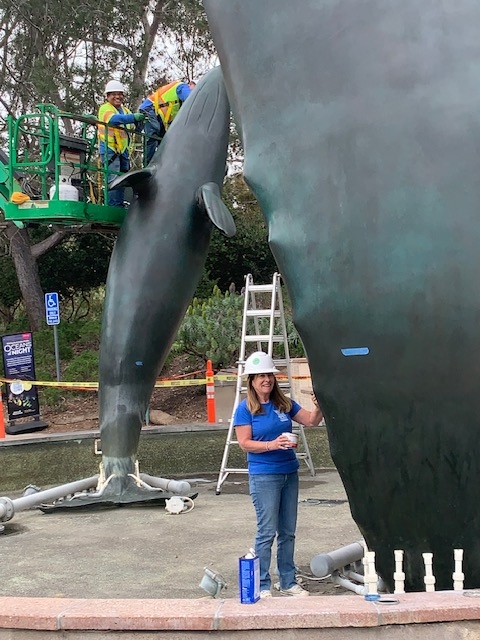
Figure 1. Cleaning the whales at the Birch Aquarium, La Jolla.
The UCLA/Getty Conservation Program is situated in the heart of sunny Los Angeles. The city’s temperate weather, diverse communities, and proximity to numerous cultural heritage institutions make it a near ideal place for students of the conservation program to learn. However, living in the city comes with its costs, establishing it as one of the most expensive cities in the world. Luckily, students don’t have to navigate these challenges alone. Thanks to donors like private conservator Andrea Morse Straus, students have support to take advantage of all the program has to offer.
Andrea Morse Straus has always loved the field of conservation. She recalls this love starting when her high school visited the Los Angeles County Museum of Art (LACMA). During the visit, they saw the conservation laboratories, which kindled a deep fascination with the profession. Even while studying studio arts and art history at UCLA, she never forgot her memory at the Los Angeles County Museum of Art (LACMA). Straus explains her journey to conservation “is a very unusual story.” In fact, she always thought she would be an art teacher, but when the time came to apply to teaching positions in LA, few opportunities were available. This unexpected roadblock led her to graduate school at Cal State San Francisco. When considering what to do after graduating, she reflected on her experience in high school. In a bold move she “knocked on the door of the LACMA Conservation Department and said ‘please let me learn.’ So they took me in!” From there she learned from conservators such as Ben Johnson and Billie Milam Weisman. Eventually she joined a private practice, Sculpture Conservation Studio (SCS), where she became a partner and now operates as principal conservator.
Since managing Sculpture Conservation Studio, Straus has deepened her love for the field through commissions in Los Angeles. This year marks 40 years since her start in conservation, and her passion for the occupation has only grown. When asked what she loves about the field she enthusiastically exclaimed “I love all of it! Everything is a new experience and fun!”
As an example, Straus recalls her experience performing treatment on Helen Lundeberg’s WPA mural The History of Transportation, a sixty panel petrochrome mosaic located in Inglewood, CA. When SCS first received the commission, the mural was in poor condition, with many of the panels covered in graffiti and others missing following an automobile accident. Straus chuckles while explaining that at first she thought, “How boring is it going to be to have to keep doing the same thing to each of the 60 panels?” However, once she started treatment, she found “each [panel] was different and more exciting than the next.” As treatment continued, she saw “the colors and scene itself come alive.” She couldn’t wait to go into work and see what she would find on the next panel.
In February of 2025, Straus had the opportunity to partner with “Save the Tiles” in Altadena to identify and help save the historic Batchelder tile fireplaces for residents who lost their homes. The experience represented a moment of communal reciprocity. Volunteers came together to salvage the remaining tiles, and residents fed them and provided supplies, such as free workboots. She remarks how amazing the experience was, especially “helping those people who lost everything.”
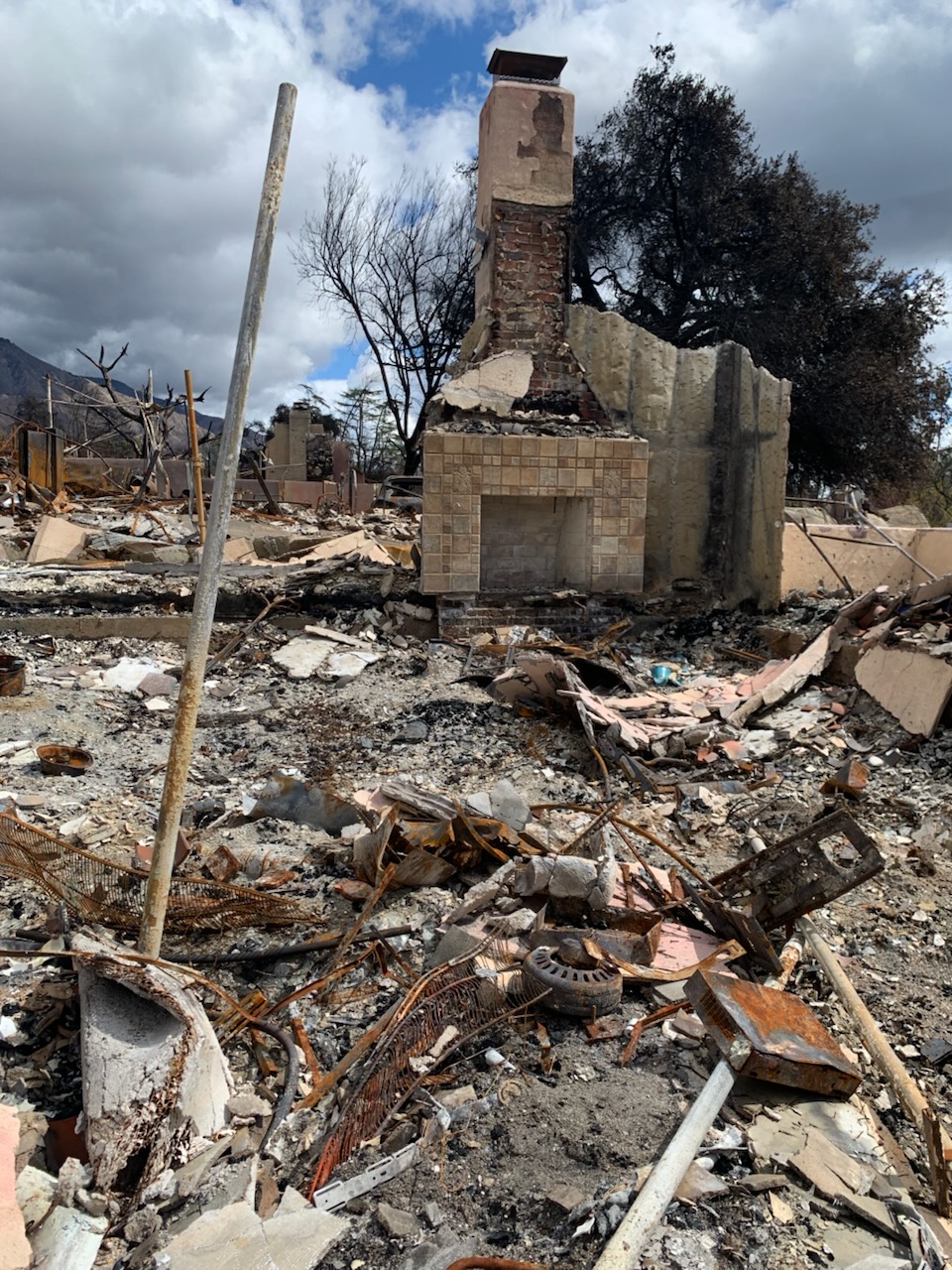
Figure 2. An example of one of many Batchelder fireplaces “Save the Tiles” were able to salvage.
Sculpture Conservation Studio also maintains the Franklin D. Murphy Sculpture Garden on the UCLA campus. This commission has brought many learning opportunities not only for her, but emerging conservators including students of the UCLA/Getty Conservation Program. Straus also hosted a scholarship program with the UCLA Department of Art that allowed art students to learn about conserving sculptures hands on, while also getting a stipend and class credit. Some students wanting experience in the field of art conservation still work with her.
Working on a public installation such as the sculpture garden comes with its challenges. Its accessibility to the public is its greatest strength and weakness. Sculptures have frequent interactions with skateboarders, curious visitors who touch the artwork, and one of the worst culprits: urinating dogs. These challenges mean every treatment session comes with unique solutions. The sculptures’ exposure to the outdoor elements means she has had to get creative with their preservation, even going as far as to change sprinkler placement or trimming nearby trees. Though these challenges can be difficult to navigate, maintenance is integral to the motivation of visitors to come.
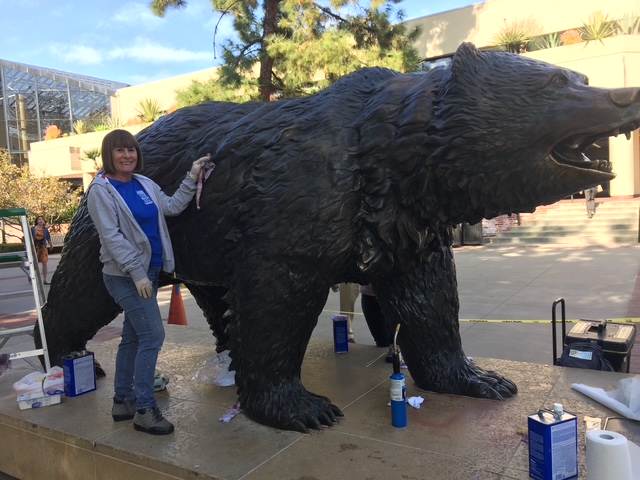
Figure 3. Straus cleaning Bruin Bear.
Through all the varied experiences she’s had since becoming a conservator, being a support to the rising generation of conservators has been one of her most satisfying accomplishments, Straus explains. Her connection to the UCLA/Getty Conservation Program stretches back to before the program was even established. It was Straus’ long friendship with Program Chair Glenn Wharton that led to her involvement with the program today. “We were having lunch and he was talking about his excitement about being appointed chair of the program. As she and Wharton spoke, he “nonchalantly” mentioned the program was looking for funding. Straus recalls asking point blank: “can I contribute?” to which Wharton replied, “sure!”
Since then, Straus has supported students and the program through donations and grants, which has become one of her long term goals. Straus also mentions her excitement in seeing what each student brings to conservation. She comments that the field of conservation has changed for the better. Now, conservation is “more about maintaining our history. I love that idea.” This change in perspective from the field is being carried on by students who want to take care of their cultural heritage, even using traditional preservation methods and materials. The impact of students working with objects they love extends beyond the conservator and into the community from which objects originate.
Getting to hear how her contribution has helped each student progress in their career is especially meaningful to Straus. She emphasizes her goal is simple: “I just want to make an impact on someone’s life and help them do what they love.” In her closing words, Straus hopes the field of conservation grows and that students “get the word out how important it is.” Pursuing conservation, according to Straus, “is a special love. It takes time, but it’s well worth it.”
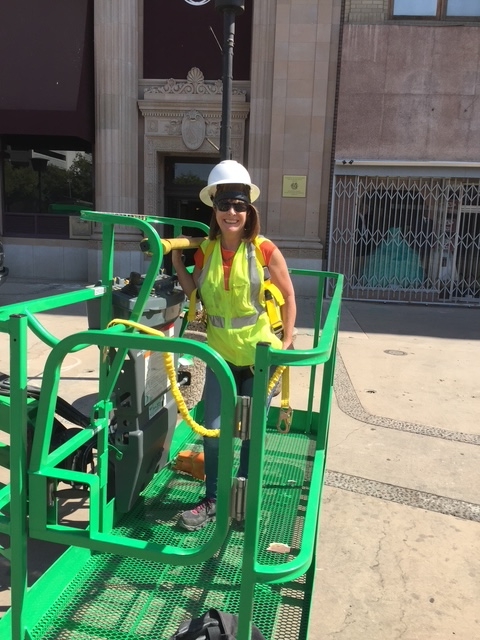
Figure 4. Straus on a lift required for accessing heritage at a height.
